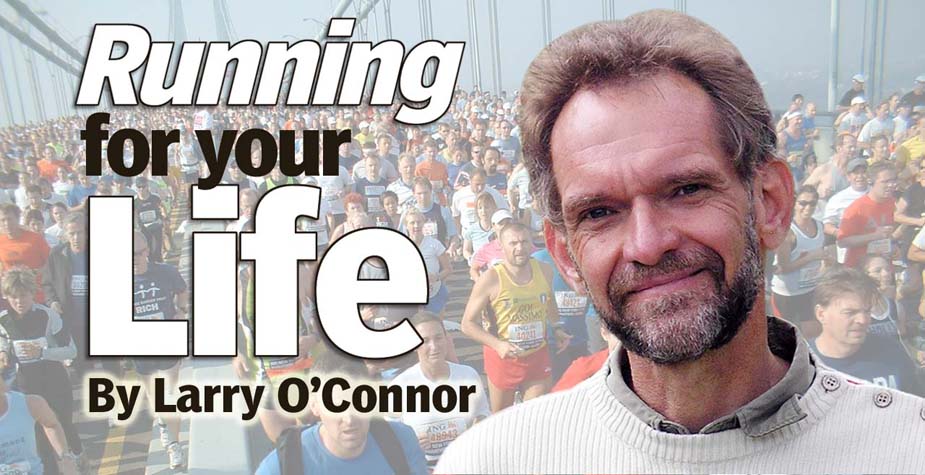
Running for Your Life: If the Greats Were With Us

When it comes to writing, the idea is to keep a diary. Why, you ask? Consider what the British poet Peter Scupham found in what the London Review of Books (Aug. 27) called “a carrier bag of diary entries and other bits and bobs.” The diary writer’s name: Avies Platt; she died in 1976. In the diary she writes about a memorable evening in 1937 when she attended a lecture of the Sex Education Society in London.

Here’s some of what she wrote in that diary:

“Two rows back stood the most striking-looking man I had ever seen: tall, somewhat gaunt, aristocratic, very dignified: a strong, yet sensitive face, crowned by untidy locks of white hair: horn-rimmed glasses, through which shone strange, otherworldly eyes. He wore evening dress, with a soft shirt. He leaned slightly forward, resting both hands on the chair in front of him, and on the little finger of his left hand was a large, exotic-looking ring.”

Wonderful. (Of course, my thought is that how special it is to be a woman observer. My wife, MM, is similarly gifted. As a man, I always feel uncomfortable staring at a person for as long as Avies must have stared to get this glorious description … )

Who was the man? None other than the poet, W.B. Yeats (1865-1939). Of course, Platt and Yeats would spend the evening together in conversation: Here’s a second gem, from Yeats himself:

“If you would write, you must get away, by yourself, into another world and write according to the vision you see there. You must write what you believe and not mind what people say. It is the only way. You know, when I come down to breakfast in the morning after writing all night, it is coming back into another world. It is as though I am not the same man, yet I am.”

Here’s a twist. Avies Platt is no longer with us. But a thoughtful poet with a great ear for a story wonderfully told has restored to us a memoir so that this amazing encounter between perfect strangers lives on, seventy-eight years after that singular evening in London, England.


Next: Running for Your Life: Marseilles Mood


Running for Your Life: Paris Mood: Quest for the Hot Courgette

It is on Rue de Bretagne, a few meters from the taste prize of a Paris Sunday, brunch at Le Marche des Enfants Rouges, that we  find in a vegetable market where all the fruit and greens are gently placed with organ softness into light-weight brown bags, their corn corners spun to close them, the 2015 Courgette. In Brooklyn, they are but zucchini, but here, on Rue de Bretagne, the flesh of the courgette beneath the grape-green skin promise like the touch of a breast of a jeune fille, forbidden of course, but if the forbidden doesn’t arise on a trip to Paris then what is the point.

Three years ago we’d come to Paris, to Le Haut Marais, when there was no memory of courgettes, because while we were staying in a fine-enough apartment, the owners of the place were in Brooklyn, for two decades or more we’ve been exchanging homes in order to travel in comfort and not break the bank paying for hotels, but that trip in June 2012, we locked into an arrangement in which the couple arrived at our Brooklyn brownstone and went straight into our bedroom, shut the door, turned down the blinds and left us wondering what was next, maybe a Minotaur into the cave that they had immediately constructed in our own house, so with that image in my mind of that trip, I frankly don’t remember much about that time beyond  the purchase of slip-on shoes so pointy that they reminded me of a bully on the playground of Dufferin Public School in Owen Sound, John Adams, by name, who’d threaten boys like me that if we didn’t get out of his way or laugh at his lame jokes that he would flick his boots at us. Now, finally, fifty years later, I was ready for John Adams. He’d flick his boots at me; I’d flick mine at him.

Despite the Minotaur threat, we came back to Paris. Last month. There are other places like this, perhaps, but in Paris for those of us who love it, the sensual basics don’t seem to change. The politics, yes. The racial imbalances, yes. It was in June 2011 that we’d stayed in a small apartment in the Marais near Le Marche des Enfants Rouges. Four years later, and we’re back in the vegetable market, MM seizes on the courgettes and has the attendant pick them out, one, two, three, four and a fist of spring onions that I gather into my backpack for the long subway ride back to our Levallois apartment, plenty of places nearby to get courgettes but we feel we have the hot ones, and yes, it is now my turn at the cooking wheel, I slice off a perfect courgette oval, dozens of them and I am cooking without olive oil, with a stranger vegetal substance that I found in a plastic tub in the fridge that counts for butter and keeps heart disease at bay, an obvious obstacle to anything much happening in the pan, but these courgettes hold up, keep their form. I wheel the gas fire up and down with the burner knob, a strange jazz that seems to work, simmering in the other pot is a whole cooked chicken, where shreds of the spring onion go, the balance in the flat pan without a handle, and there is no way of knowing until all of this is brought to the table, the courgette sliced too thin, only now do I realize that I’d pressured my perfect courgette, which tasted of chicken skin and schmaltz and spring onion darkened in an overheated pot, a meal that filled our stomachs but left me aching for more. That kept me on my quest for my 2015 Courgette.

Next: Running for Your Life: Marseilles Mood   


Running for Your Life: If the Greats Were With Us Thursday

I was too young. Just six years old. So I’m not going to make this about a personal memory. But when Marilyn Monroe died under mysterious circumstances on August 5, 1962, fifty-three years ago, The Sixties officially began. Give me the counterculture, baby, because the mainstream culture, the one that takes the life of an innocent like Norma Jeane Mortenson isn’t worth pondering.

Also in this vein, that time marked the very first televised presidential debate. The broadcast occurred on Sept. 26, 1960 and featured John F. Kennedy (“Happy Birthday, Mr. President” was sung by MM on May 19, 1962, seventy-eight days before her suspicious death) and Richard Nixon. How far we’ve come from Nixon’s five o’clock shadow to Donald Trump’s orange hair.

The Sixties, of course, are long gone. Today’s atavistic nihilism fosters a voracious appetite for the premiere of the sixth season of “The Walking Dead.” Tune in on Oct. 11.

If Marilyn were alive today, she’d be 89 years old. If only she were with us.

Next: Running for Your Life: Paris Mood


Running for Your Life: The Subway. A Public Good?

If we view the subway as a public good, what better way to spend money raised in taxes from mass transit than an underground train and a comfortable climate-controlled motorbus that for a reasonable fee takes you to distant places in a sprawling urban metropolis like New York City. And yet, for those working to provide these services, an observation:

What appears to be the indifference of scheduling that will, regularly during my daily commute, thwart a very convenient transfer when the D Train, an express line to Manhattan, arrives in Brooklyn’s Atlantic terminal less than a minute before the announcement of the arrival of the northboard local R train. The doors open for the express, then close, the R Train pulls into the station with, on average, several hundred commuters like me looking to make this desirable transfer, only to be disappointed, if not angered, by the sight of the express train pulling out of the station.

How to feel for the motorpeople and conductors on both of these trains. All day long this happens, say, in a regular eight-hour shift, in places all along the system, each time the train employees have to feel the charged energy of the poorly served fee-paying passengers. A week, a month of this kind of inhumane treatment and what results? A disrespect for the riders, the losers and poor saps. The absence of pride that comes from a job well done. At best, a sense of frustration that their bosses obviously don’t give a hoot about them, the front-line workers who must fill the impossible roles of being just cogs in a wheel that doesn’t roll as it should.

It would take only a simple tool to fix this scheduling problem, to correct it like one does a flat tire, but the bosses don’t think enough of their workers to provide them the tool. So they give up. Drive the train; open the subway doors. Collect their pay. The promise of a public good lost in the miasma of bureaucracy.

Next: Running for Your Life: Paris Mood 2015


Running for Your Life: Plain Train Game

Maybe this isn’t for everybody. Especially in the heat of the summer. But last year at this time, K and I were gearing up for a summer marathon and a half-marathon. I’ve never taken any time off during even the hottest days of the summer (On those, full disclosure, I’ve taken to going to the air-conditioned comfort of our neighborhood gym to run on the treadmill, but still …).

It’s one thing (and definitely a good thing) to jog at a light pace – say, a 10-minute mile or a 9:30-minute mile. But another to train on the treadmill at a faster, stronger pace, closer to an average of 8:40 during an hour-long training session, with up to 3.0 incline, and interval speed increases of five-minute blocks, combined with, on alternate days, stretching and working on core, leg and upper body weight machines. Because now, with four months to go before race day at the Brooklyn Marathon, it’s time to get my training focus. I want to run this marathon – not run-walk it the way I did from the 21-mile mark in the 80-plus degree heat of the Nova Scotia Marathon last July.

That’s the Plain Train Game. And I’m locked in. Thankfully, each session ends with me feeling just a little bit better than the time before. I ease off when I feel a muscle strain coming on. But the Marathon Mood is striking. Number 9!

Next: Running for Your Life: The Subway. A Public Good?