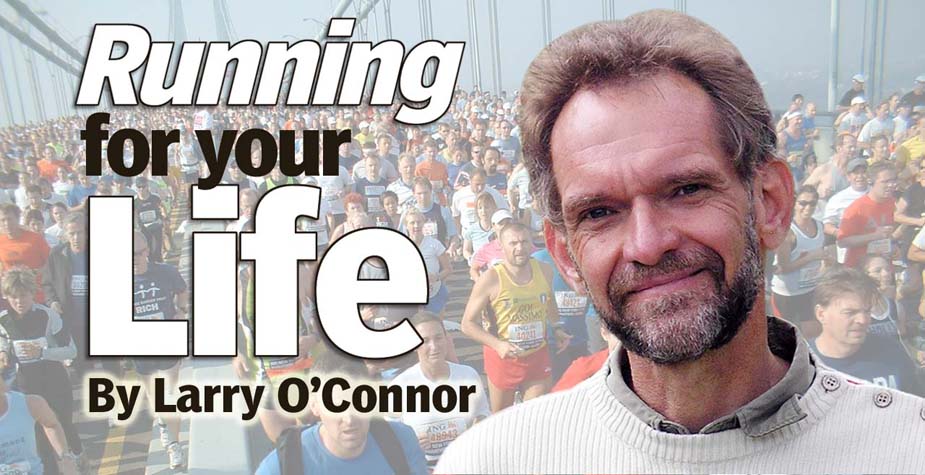
Running for Your Life: If the Greats Were With Us Thursday

I was too young. Just six years old. So I’m not going to make this about a personal memory. But when Marilyn Monroe died under mysterious circumstances on August 5, 1962, fifty-three years ago, The Sixties officially began. Give me the counterculture, baby, because the mainstream culture, the one that takes the life of an innocent like Norma Jeane Mortenson isn’t worth pondering.

Also in this vein, that time marked the very first televised presidential debate. The broadcast occurred on Sept. 26, 1960 and featured John F. Kennedy (“Happy Birthday, Mr. President” was sung by MM on May 19, 1962, seventy-eight days before her suspicious death) and Richard Nixon. How far we’ve come from Nixon’s five o’clock shadow to Donald Trump’s orange hair.

The Sixties, of course, are long gone. Today’s atavistic nihilism fosters a voracious appetite for the premiere of the sixth season of “The Walking Dead.” Tune in on Oct. 11.

If Marilyn were alive today, she’d be 89 years old. If only she were with us.

Next: Running for Your Life: Paris Mood


Running for Your Life: The Subway. A Public Good?

If we view the subway as a public good, what better way to spend money raised in taxes from mass transit than an underground train and a comfortable climate-controlled motorbus that for a reasonable fee takes you to distant places in a sprawling urban metropolis like New York City. And yet, for those working to provide these services, an observation:

What appears to be the indifference of scheduling that will, regularly during my daily commute, thwart a very convenient transfer when the D Train, an express line to Manhattan, arrives in Brooklyn’s Atlantic terminal less than a minute before the announcement of the arrival of the northboard local R train. The doors open for the express, then close, the R Train pulls into the station with, on average, several hundred commuters like me looking to make this desirable transfer, only to be disappointed, if not angered, by the sight of the express train pulling out of the station.

How to feel for the motorpeople and conductors on both of these trains. All day long this happens, say, in a regular eight-hour shift, in places all along the system, each time the train employees have to feel the charged energy of the poorly served fee-paying passengers. A week, a month of this kind of inhumane treatment and what results? A disrespect for the riders, the losers and poor saps. The absence of pride that comes from a job well done. At best, a sense of frustration that their bosses obviously don’t give a hoot about them, the front-line workers who must fill the impossible roles of being just cogs in a wheel that doesn’t roll as it should.

It would take only a simple tool to fix this scheduling problem, to correct it like one does a flat tire, but the bosses don’t think enough of their workers to provide them the tool. So they give up. Drive the train; open the subway doors. Collect their pay. The promise of a public good lost in the miasma of bureaucracy.

Next: Running for Your Life: Paris Mood 2015


Running for Your Life: Plain Train Game

Maybe this isn’t for everybody. Especially in the heat of the summer. But last year at this time, K and I were gearing up for a summer marathon and a half-marathon. I’ve never taken any time off during even the hottest days of the summer (On those, full disclosure, I’ve taken to going to the air-conditioned comfort of our neighborhood gym to run on the treadmill, but still …).

It’s one thing (and definitely a good thing) to jog at a light pace – say, a 10-minute mile or a 9:30-minute mile. But another to train on the treadmill at a faster, stronger pace, closer to an average of 8:40 during an hour-long training session, with up to 3.0 incline, and interval speed increases of five-minute blocks, combined with, on alternate days, stretching and working on core, leg and upper body weight machines. Because now, with four months to go before race day at the Brooklyn Marathon, it’s time to get my training focus. I want to run this marathon – not run-walk it the way I did from the 21-mile mark in the 80-plus degree heat of the Nova Scotia Marathon last July.

That’s the Plain Train Game. And I’m locked in. Thankfully, each session ends with me feeling just a little bit better than the time before. I ease off when I feel a muscle strain coming on. But the Marathon Mood is striking. Number 9!

Next: Running for Your Life: The Subway. A Public Good?


Running for Your Life: If the Greats Were With Us Thursday

So much to quote about the great “Swoonatra” piece by Ian Penman in the July 2, 2015, edition of the London Review of Books, about the incomparable Frank Sinatra (1915-1998), in parts an elegy for a time when listening to music meant a long-playing album, what Sinatra was first to see as “an opportunity for sustained mood music, a pocket – (my aside between em dashes) what a deft phrase, dated and intimate, oooh so pre-Internet – of time focused entirely on one defining concept or tone.”

And,

“It’s no coincidence that so much music from the next decade sounded so good, and still does, half a century on. At this make or break point (the 1950s), many jazz-schooled musicians saw which way was up and swapped the marriage-destroying purgatory of touring for well-remunerated union-protected session work.”

And, most pointedly, when it comes to our theme, If the Greats Were With Us:

“When today’s stars try to pull off an imitation of old-style song craft they may get the surface details right, but they completely miss the center of gravity, or sense of connective purpose.”

Finally,

“It’s doubtful any singer will ever again possess that kind of sway. Who could reign as monarch of so much territory, and certainty, ever again? Maybe he is our last voice, at that.”

Next: Running for Your Life: Plain Train Game


Running for Your Life: Get Stoner!

It might not qualify as the best opening lines in fiction, and if John Williams (1922-1994) had have submitted this to an agent in 2015:

“William Stoner entered the University of Missouri as a freshman in the year 1910, at the age of nineteen.”

Chances are it wouldn’t have risen up and out of the slush pile. But do yourself a favor this summer and get Stoner!

“Stoner,” the novel by John Williams, has been reissued by the invaluable New York Review Books series, with an introduction by the great Irish author, John McGahern. Here is what McGahern (By the Lake, Amongst Women, The Dark, The Barracks) had to say about Stoner:

“If the novel can be said to have one central idea, it is surely that of love, the many forms love takes and all the forces that oppose it.”

In these days of the shortest of short attention spans, first lines of fiction usually clump in the extraordinarily clever or brilliantly concise, say in the variety of George Orwell’s “1984”: It was bright cold day in April, and the clocks were striking thirteen.”

But then there are those that catch fire like “Stoner” does, and don’t stop burning brightly until the end, with, in his case, perfectly chosen words in a final passage that leave us in awe of what it can mean to tell a story as large as life itself from such a simple beginning.
  

Next: Running for Your Life: If the Greats Were With Us Thursday