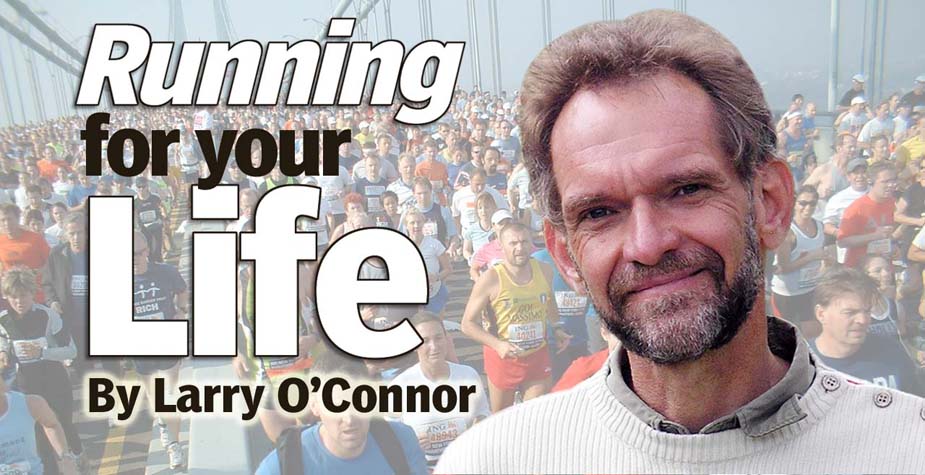
Running for Your Life: The Real “Frankenstein”

Nothing is so painful to the human mind as a great and sudden change.”

I found myself, while reading Mary Shelley’s “Frankenstein” for the first time (I finished the novel this week) meditating on the above line from Victor Frankenstein. To this human mind, that’s the line that best describes the novel’s theme. 

For reasons that I’d always found a little baffling, when it comes to the monsters we know as children – Frankenstein, Dracula, the Werewolf – I’ve always been drawn to Frankenstein.  Now, after reading Shelley’s slim but powerful volume, I get it.

“Frankenstein” is as relevant now, it seems to me, as when it captured the public imagination after publication in 1818. (The one I read – at right, the Signet Classic paperback version, 1965 – is a reprint of the 1831 republication, which was heavily revised by Shelley [when she was in her early thirties)]. Next, I’m going to read the first one – before the revision. The one that came to her in a dream.

“This one was working,” Gertrude Stein said of Picasso. Maybe that’s what makes a classic.

What is birth but change? My daughter, K, is coming home next Thursday. I will go and pick her up at the airport. When I see her I will think of what it felt like to read those first tortured yet graceful thoughts of the demon (in the novel, Frankenstein is the creator, his creation never ranked above “demon” or “beast” as a third-person reference). As children, we don’t have the luxury (the torment?) of sharing our deepest feelings with our creator. Instead, we must settle for a poor second, our parents, a poet’s task.

One of the chief tragedies in “Frankenstein” is the change the demon implied mortally threatened the humans he encountered during his brief time on earth. If they could have seen him, as he was inside, his life would have changed for the better, one that did not take him off to the ends of the earth (the far north, which is another story …).

Like an acolyte before a teacher, I’m drawn to the demon, to his capacity to feel and value the idea of being the best a man can be. “This one was working,” I’ll say to K when I see her.

Next: Cross Train, No Pain  


Running for Your Life: Off-Road With Thurb

You don’t have to have a redbone coonhound to train with. But it helps.

I’ve been running with Thurber (at right), who turns three in June, since he was little more than a pup. It’s not that Thurber has come to gather up his leash in his mouth and follow me around the house. He doesn’t show that type of enthusiasm. Rather, when he sees me in my running gear, and I say, “C’mon, Thurb! C’mon! Are you up for a run?” You know what? He always is.

Winter or spring, fall or summer. He’s ready to go. We’re a pretty good fit, Thurb and I. He pours on the after-burners in the beginning, and it is all I can do to keep him on leash. (If you’re imagining a sped-up version of the Cleese Walk as I struggle to stay with him, you’re not off the mark.) Off-road in Prospect Park, Brooklyn, where we run, except for the occasional manic lunge after an unsuspecting squirrel (which, at his best, he manages to chase to a tree, which the rodent scales, and Thurb runs to its base where he leaps a foot off the ground),  he will settle into a trot alongside me in a way that makes me think of the standardbred sulkies at the Hanover Raceway back home in Ontario.

He’s such a creature of habit that he knows our route, slows to make our turns, looks up to me as if to say something, but never anything critical – or even complimentary. Never does he look at me in a way that I think I may if the paw were on the other foot that says, “Is that the best you can do?”

If anything, his look is one of quiet assessment. As if to say that it is surprising enough that this beast following me can run as well as that on only two legs. Which during marathon training is a comfort, I can tell you.

Next: Running for Your Life: The Real “Frankenstein”   


Running for Your Life: A Tribute/4:06:09

After a certain age we don’t have babies. But if we take care of ourselves, we can run marathons.

Last year I ran Boston. The weather was in the mid-80s, unbearably hot on the city streets. But it was like a party and we runners were the lords and ladies, the rock stars, the heroes. The cheering and good feeling so infectious that despite the pain and punishing heat, so many of us scaled Heartbreak Hill without stopping and managed to cross the finish line in the triumphant spirit shown in the photo at right. Like having a baby, it was an achievement of a lifetime.

I confess to having been unaware of the day yesterday (April 15), the 117th running of the Boston Marathon. I had not qualified for this event, so my attentions were elsewhere when I saw the first images, most especially the one that has been repeated again and again, showing the finish line where I was so deliriously happy a year ago, and the time on the race clock: 4:06:09. Only minutes later than when I ran across the line a year ago.

I weep for those who died, the suffering and the loved ones. There are no words. But hopefully many attempts at them, because to my mind words claim the sacred space that viral videos on smartphones defile.

Consider the phrase: 4:06:09. Meditate on it. We pause now to weep, to think on 4:06:09, and the lives that have been lost and changed. Lace up your sneakers and start with a walk. Soon, the training begins anew, with the promise of the finish line ahead.

Running for Your Life: Steamtown 2013

Without a slip this time, I’m in! Last month I lost a screwball race to Chicago Marathon registration, but yesterday (April Fools’) I registered successfully for the Steamtown Marathon that’s held every year in Scranton, Pennsylvania. This year the race is scheduled for Sunday, Oct. 13.

I won’t be training in earnest until mid-June. And race goals? If ever I have a shot to top my personal best of 3:33:08 (Steamtown 2010), it will be in October.

It’s beautiful in the fall in northeastern Pennsylvania. And if you’ve ever considered training for a marathon, make it this one. We start in the hills and end in downtown “Electric City” Scranton. Come along with me. You won’t be sorry.

Next: Running for Your Life: Off-Road With Thurb


Running for Your Life: Full Nelson

These days I’m deep into THE MAN WITH THE GOLDEN ARM by Nelson Algren.

An eon ago characters like junkie-dealer Frankie Machine and his wife Sophie stirred the popular imagination, winning the National Book Award for Algren in 1950. Five years later an Otto Preminger movie starred Frank Sinatra (natch) in the title role; Frankie was nominated but failed to win the best actor Oscar. (It went to Ernest Borgnine for his role in “Marty.”)

THE MAN WITH THE GOLDEN ARM is a standout of literary realism, a classic that mines the mean streets of Chicago through a Proust processor of observed delights and dangers. What Proust does in the Belle Epoque, Algren does for Division Street, Chicago, in the 1940s. How does the lace curtain move during the night in an apartment kept just this side of chaos by a superintendent named Jailer? Read it in Algren.

Take the Great Sandwich Battle in which unlike so much of modern fiction the mockery is bone-deep, not on the surface, so the effect registers on all the warriors: Vi, Stash and Sparrow sing like an opera rather than prance like a musical, in the latter’s case soon to be as forgotten as the outcome of table games or the content of get-through-the-night conversations, disposable as Poland Spring.

Next: Running for Your Life: Spring Goals