Running for Your Life: Apologize, Me?

“Never apologize, never back down, never admit you were wrong, use every means possible toward achieving your ends.”
- Lawyer Alan Dershowitz, on what the late master-fixer Roy Cohn taught Donald Trump

“That was the biggest f—kng mistake I’ve made. You never make those concessions. You never apologize. I didn’t do anything wrong in the first place. Why look weak?”

- Former White House aide Rob Porter on Trump’s reaction following his “reset” remarks in response to saying that both sides have a lot to answer for in the wake of the deadly white supremacist march in Charlottesville, Va., as reported in Bob Woodword’s “Fear”    

Next: Running for Your Life: Tree Gait


Running for Your Life: The Overstory Story

This is going to be short – and oh, so sweet.

The first words that I read after turning the last page of “The Overstory” by Richard Powers appear in the 1954 Dell Laurel paperback edition (95 cents!) of “Six Great Modern Short Novels,” the preface to “The Bear” by William Faulkner, most of which contains remarks to honor the winning of the Nobel Prize for Literature in 1949, to wit:

“It is [the writer’s] privilege to help man endure by lifting his heart, by reminding [her] of the courage and honor and hope and pride and compassion and pity and sacrifice which have been the glory of [her] past.”

What’s more, “This award is only mine in trust.”

“Our tragedy today is a general and universal physical fear so long sustained by now that we can even bear it. There are no longer problems of the spirit. There is only the question: when will I be blown up.”

“Because of this the young man or woman writing today has forgotten the problems of the human heart in conflict with itself which alone can make good writing because only that is worth writing about, worth the agony and the sweat.”

This is what “The Overstory” aspires to and succeeds in doing: realize the promise of Faulkner’s call for humility in service to the human spirit.

What “The Overstory” does 67 years after Faulkner penned these words is, through agony and sweat,  lift our hearts [and I daresay minds] during the interregnum of our annihilation.

Next: Running for Your Life: Tree Gait


Running for Your Life: Endless Summer

You never know when the hot is coming on.

We’re a tolerant lot, especially those working stiffs on New York City subway platforms

Right stuff of draft card soldiers in a tropical war

Recruits steel themselves

Stiff upper lip, not a whimper in the crowd

Glass doesn’t break but shatters

Humans at work revealing weakness

The first step toward

An ever-widening gulf of hope-hammered unemployed

Nary a crack in the armor

Long accustomed to being invisible to others, if not themselves.

So the hot will keep coming

Underground humans inured

Active-passive, even joys withheld

Aboveground humans oblivious for reasons better left for discussion at another time.

Hot enough for you?

Brother, you got no idea.

Next: Running for Your Life: Reel Back Some


Running for Your Life: Troubling Parallels

Head-in-the-sand folks are driving me to sobriety.

Why? Because never before in my life as a citizen have I been confronted by certain troubling parallels. Man, do I feel that I need to have my wits about me.

They (the parallels) wouldn’t be in such sharp relief were I not devouring the book, “The Nazi Séance” by Arthur Magida.

Which caused me to pull down from our shelves Bill Shirer’s classic, “The Rise and Fall of the Third Reich.”

Shirer’s tome begins with this epigraph:

“I have often felt a bitter sorrow at the thought of the German people, which is so estimable in the individual and so wretched in the generality.”   – Goethe

And the foreward ends with this:

“In our new age of terrifying, lethal gadgets, which supplanted so swiftly the old one, the first great aggressive war, if it should come, will be launched by suicidal little madmen pressing an electronic button.”

And some choice fragments, quotes from “Nazi Séance:”

“[Our leader] is a holy gift for people who needed the comforting rumor that a messiah had been sent to lift them from their suffering, their pain and their sorrow.” (from John Toland’s “Adolph Hitler)

As a young man, the anti-hero in “NS,” Jewish magician-entertainer Erik Jan Hanussen, ne Herman Hanussen, observes:

“It is like this always in life: the bolder one wins.”

And …

“If a life is constructed on a lie – and on a lie that is eminently successful – why pay attention to the truth?”

Berliners, in Hanussen’s view, were of a superior kind, preferable to the “mawkish Austrians, the perverse French, the boring English and the stupid Americans.”

Hitler was a devotee of 17th century mystic Balthasar Gracian, to wit, “The truth, but not the whole truth. Not all truths that can be spoken.”

What Hanussen would suggest, to be a showman first, “Mix a little mystery with everything, and the very mystery arouses veneration.”

Next: Running for Your Life: Endless Summer
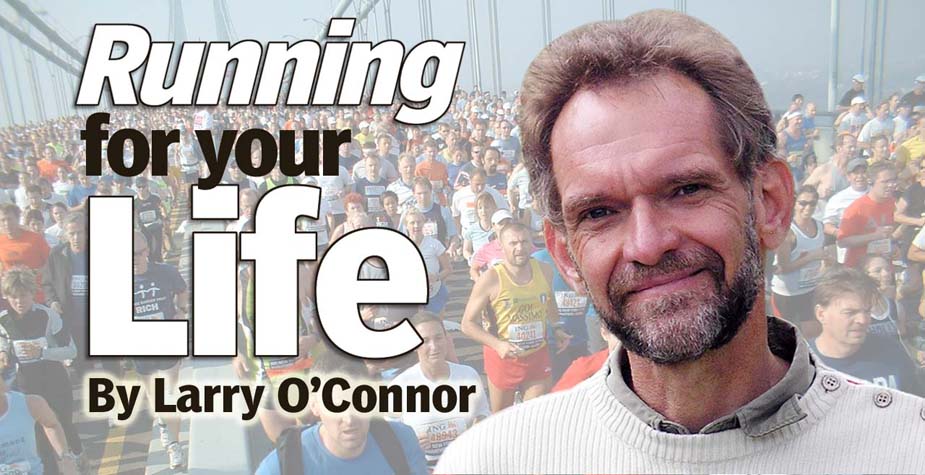


Running for Your Life: Finding Sebald

Pretty much on a daily basis … OK, not that frequently, but more than weekly … I find a book treasure in my neighborhood.

Recently, “Vertigo” by W.G. Sebald, his first novel. A huge fan of this writer, I couldn’t put down “The Emigrants” and “The Rings of Saturn.”

So much here, tailor-made for a writer searching for simplicity of voice. What happens? Pretty much just the interior narrative on a cultured man – questing, forever questing.

I could make a list of the gems I’ve found in the past few months but today (Aug. 28) I’m all about how Finding Sebald couldn’t have come about at a better time.

Consider these wonderful observations in “Vertigo,” amazingly pertinent comments to our strange social-political moment:

“Liken a lucid mind to a glass, which does not break of its own accord. Yet how easily it is shattered.”

“Machines alone have realized that sleep is no longer permitted.”

And most nakedly,

“Ceaselessly, in great surges, the waves roll in over the length and breadth or our cities, rising higher and higher, breaking in a kind of a frenzy when the roar reaches its peak and then discharging across the stones and the asphalt even as the next onrush is being released from where it was held by the traffic lights. For some time now I have been convinced that it is out of this din that life is being born which will come after us and will spell our gradual destruction, just as we have been gradually destroying what was there long before us.”

(That last quote could serve as the ideal epigraph for THE OVERSTORY by Richard Powers …)

Next: Running for Your Life: Troubling Parallels