Next Thursday is Thanksgiving, the food holiday to end all food holidays. For one day in the US calendar (Sure Canadians hold Thanksgiving, but my recollection has it that they doesn’t overly glorify the goodies: squash, brussels sprouts, cornbread stuffing, sweet potatoes, shoofly pie, every conceivable way of cooking a turkey so that I swear to God one day a book the size of the OED will be published with the complete
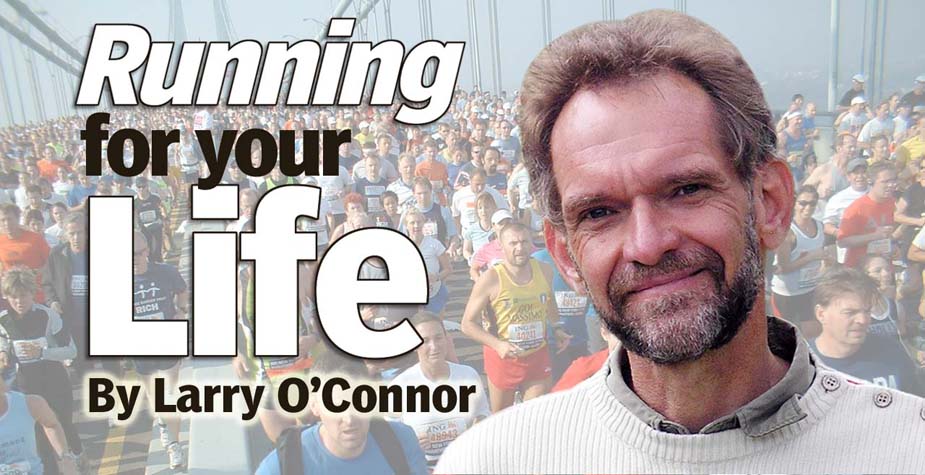


Running for Your Life: The Road North
My New York Post colleague is attending a post-marathon party and I’m at work with my pal, Mike. (In New York, there is ONE and only ONE, marathon.)
In an e-mail explaining further, she says it is a marathon/engagement party.
“Sounds like a surprise,” I say in an e-mail reply.
“Yes, he popped the question at the sixteen-mile mark.”
“Ha!” Mike says. “Now the real marathon begins.”
*
If a marriage is a conversation that ends too soon, as Andre Malraux says, then like every good conversation, a pause refreshes. That was what I was thinking recently while I was motoring north and west from Brooklyn to near the Canadian border, some 370 miles.
I’ve known B, a TV anchor in Watertown, New York, since grade school, and we’d longtime plans to spend a weekend with a mutual friend, G, an actor and writer from Toronto. M had plans for a conference in Iowa, and to see her mom, a year shy of a century next month, when we’d all be trooping to Milwaukee to see her.
There are times like this that I write in my journal that time stands still. On many previous visits to Watertown, I’ve run the roads. At the end of B’s street and up is the entrance to mild-slope hilltop Olmsted-and-Vaux Thompson Park, with stone walls built by WPA crews sprouting in the green grass and from a secluded lookout, on a day not so unlike the Saturday I’ve visiting, bright and sunny with the Titian sky, a photographer, Willabel Cole Mitchell, took “Entre Nous,” that vintage poster-shot of three girls on
Running for Your Life: Marathon des Sables
They ride camels in Morocco. Or at least in Merzouga. After Fes, we started on our way, driving to the distant village of Merzouga. M and I had for the past few months perused a friend’s guide to quintessential Moroccan riads – guest houses – each, as far as we can tell with an inner courtyard oasis of date palm trees and cacti and grasses, and at our riad in Fes, a banana tree, where we could see because it has been ages since we’ve been in the tropical house at the Central Park Zoo that the fruit that cartoonist Roz Chast felt compelled to write a paen to it in The New Yorker grows upside down, so that when you grab a banana and peel it, you doing it from the bottom (stem) to the top (black hard bit).
But there are no bananas in the Sahara. Mohammed is our camel host and salad chef. The blue woven saddle
But there are no bananas in the Sahara. Mohammed is our camel host and salad chef. The blue woven saddle
Running for Your Life: Question Period
OK, enough about me. (Is that even allowed in a personal blog?!) I know I have some readers, or at least a browser or two – Yes! Bounce Rate – so let’s kick it back to you.
My friend, Jacki, wants to know how to do it. Not just run for her life; she has been doing that, in three-mile bursts four or five times a week for a long time, but she has never run a marathon and is intrigued by the idea of doing so. However a friend and exercise expert tells her to fuhgeddaboudit; try swimming, or cycling or low-impact aerobics (shoot me now), not running; running destroys the joints, it’s an exercise-killer not an exercise-accelerant.
I could – and have done in this blog – cited my experts: the "Born to Run" camp who in my view rightly say that done the right way, as in "sitting" in a mechanically sound pace that fits your body type, you can run, not
My friend, Jacki, wants to know how to do it. Not just run for her life; she has been doing that, in three-mile bursts four or five times a week for a long time, but she has never run a marathon and is intrigued by the idea of doing so. However a friend and exercise expert tells her to fuhgeddaboudit; try swimming, or cycling or low-impact aerobics (shoot me now), not running; running destroys the joints, it’s an exercise-killer not an exercise-accelerant.
I could – and have done in this blog – cited my experts: the "Born to Run" camp who in my view rightly say that done the right way, as in "sitting" in a mechanically sound pace that fits your body type, you can run, not
Running for Your Life: 'IMUS' in Tangier
The truth is I can’t see it. Not on this first run in Morocco. Tangier. Not in the old city, the medina, it’s called, or the Casbah, or citadel, forever changed by a single song by the Clash, “Rock the Casbah,” and now Moroccan houses, really just two bedrooms, a kitchen and a sitting area (what more do you need?) are bought up, walls knocked down, and become home to the third wave of jet setters, at Manhattan prices. Nine hundred and more streets, some the narrowest of passageways but cars and small trucks can bring goods up through the tourist row, the dark rattan chairs of the Café Central that nods to Rick’s Café Americain, and another time, because M and I are here in the morning before the European ferries arrive, and can imagine how foreign the glamour of the likes of a Humphrey Bogart and Ingrid Bergman would be in Tangier 2010. Yet Tangier still bears the imprint of its artists and socialites, famously Barbara Hutton, the Poor Little Rich Girl, the Woolworth heiress who died thirty years ago, and in the cobbles, embedded, are
Subscribe to:
Posts (Atom)