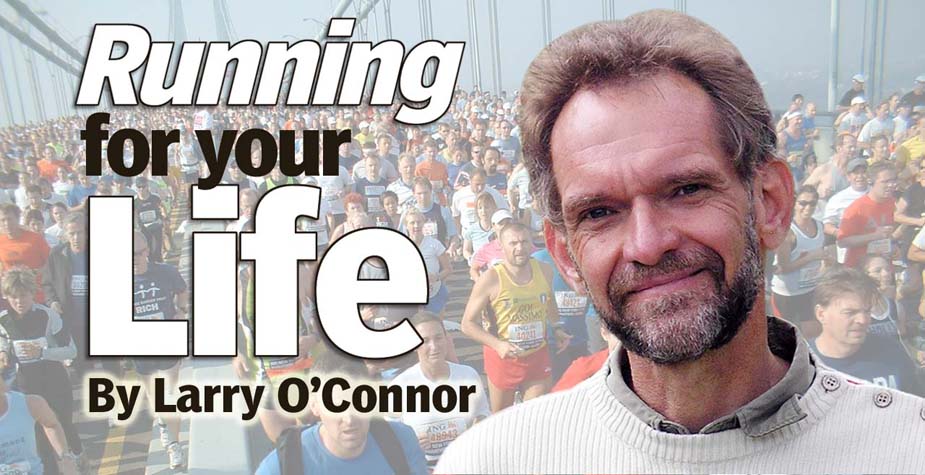
Running for Your Life: So Slow That Everything Changes

Some times injury can lead to rare and beautiful things.

Let me explain:

On Friday, Oct. 30, I suddenly and frighteningly felt something snap in my knee, at the outside edge of the patella while running at a training pace on a treadmill at my local gym. Luckily, I stopped immediately by straddling the fast-moving track, escaping further certain injury.

I hobbled home and for that night and the next day left the house only to see a doctor on emergency call. He hesitated to say what was wrong, noting that I could bend and extend the leg without pain. But when I put any weight at all on that leg, the pain was fierce. The doctor prescribed an MRI, which I had on Monday.

Early Tuesday I went out for a walk. Using a cane I was able to make it slowly up our Brooklyn block to a place where M and I typically stop for coffee before continuing on up the street in order to give Thurber, our cantankerous coonhound, a morning run in Prospect Park. The road to the park from my house earns the neighborhood’s name, Park Slope, to a considerable degree, especially noticeable when the best you can do is put about ten percent of your bodyweight on one of your legs.

So on this day M continued up the vertical street, and I stayed behind with my coffee and cane, sitting on a wooden bench fashioned around a street tree.

Suddenly, my heart filled with the promise that comes of seeing beautiful things in a brand-new way. I had never in my twenty-five years that we’ve been living in Park Slope noticed the feathery glory of a mature exotic cedar that grows across the street from our habitual cafĂ© at First Street and Seventh Avenue. The tree glowed a golden-crimson, the needles in the autumn light the texture of angel hair. Not the pasta but the celestial wonder. Red bricks on the building behind the tree reminded me for the first time in ages of our year in Santa Fe, when we traveled to see the ancient structures of the Anasazi, the dance rituals of the Hopi.

For the first time since I heard and felt that troubling knee-snap, I smiled without irony, without a sense that my running days were numbered.

I’d like to think that the days that followed form a direct line from that upbeat insight. My injury turned out, remarkably and gratefully, to be a bad sprain. I will miss the Brooklyn Marathon this Sunday (Nov. 15), but I suspect I will be running again before the snow flies.

And I hope that I’ve learned a lesson. Not so much about training and how to do it with more patience and awareness of what my six-decade-old body can or can’t do (although, I promise to try). But more about the rewards that come from truly slowing down, and seeing and taking in the beauty that is all around the all-too-busy you.

Next: Running for Your Life: Water Walking


Running for Your Life: Hubris Handicap II

Pigheads don’t fly!

Last week, I had a sore heel. This week, after running far too hard and too long in order to try to get myself ready for the Brooklyn Marathon on Sunday, Nov. 15, I learned I have a partial tear of the medial meniscus of my left knee.

My current knee pain overtook that heel bit … Funny how a new OW-EEEE ! will supplant the other. Foot pain? It’s nothing compared to how my knee feels.

But not looks. Thankfully there is no swelling and what seemed to be sure-thing surgery may be less than that. Physical therapy and anti-inflammatories, rest and who knows I may just be back out there before the snow flies.

There. Well. To the chalkboard. Trained for eleven marathons. Finished six. Injured for two (Boston 2011, Brooklyn 2015). Forced to cancel for person reasons for one (Rome 2008). Injured during the race and unable to finish for two (Ottawa 1985, Windsor-Detroit 1987).

A wise person (my wife M, in case you're asking) would say that would be just enough of the marathoning thing.

I don’t know. My darling daughter K has arranged a hockey evening (Islanders at home to play the Canadiens!) this month to help soothe may marathon-missing blues. As to the idea of letting this pastime fade into history, well that ship has yet to sail. But one thing is certain: I’m determined in the months ahead to go back to running for my life.


Next: Running for Your Life: The Long, Hot Stretch   

Running for Your Life: Hubris Handicap

When it comes to being pigheaded, runners training for a marathon win the prize.

How else to explain the way we balance pain (garden variety or thin edge of horror-type) and the base fitness level necessary to run 26.2 miles at one time and not fall apart at Mile 16, or hit the wall at Mile 20.

From that first marathon when I was twenty-seven in 1983, training with my pal JM from Brockville, and running too with my childhood friend GD, we often mentioned that we had to get the miles in the bank. No excuses.

So I sit on the subway writing this (Oct. 27) with not just a sore heel – as described in this space last week – but with a diagnosis of mild cases of both Achilles tendonitis and plantar fascia. My right foot doesn’t hurt flat as they are on the floor of the subway. But when I get up and walk around, go up subway stairs. Oweeee !

When it comes to running (and races) I favor doctors without borders. My kind podiatrist has me with a PT program that rocks – and a pledge to shoot these dogs with steroid painkillers in the event the condition doesn’t settle down by race day (Nov. 15).

In the meantime, that means exercises as prescribed by my doctor and my new physical therapist, and running when the pain subsides some. Otherwise low-impact cross-training. At night, massage the bottom of my foot with a tennis ball, treat the inflammation by step-and-roll on a frozen water bottle.

All for the race. My hubris handicap? Maybe. But how do I know? Being pigheaded has its advantages.


Next: Running for Your Life: The Long, Hot Stretch   

Running for Your Life: Roman Mood

Back from a best time of your life family vacation in Rome. We’re talking walking, eating pasta and drinking wine and amaro. Below is a taste of what we found:

Imperial Past I

This place Roma is one in which
People resist the other
While kissing her on both cheeks
And then a third time
To seal the illusion.

Imperial Past II

When you are so long gone
From being the Imperial
What to do but cling to
Your exception, no maps will
Mark the spot, find the center,
Your desire on terms of the ancient conquerors,
A mind game that isn’t tied to rules
You can possibly understand
And that, best of all, are so
Pre-digital as to make even the squarest
Disciple bow in disbelief.

Imperial Past III

We’re on board Alitalia, the nine-hour flight home. The plane so tight there is no extra room, a knee-crusher, and me with my deep vein thrombosis concerns. It’s been more than fourteen years since I’ve popped a blood clot, but the fear of spitting off a new one never leaves.

K is sitting across the aisle, trying to read “Wild” by Cheryl Strayed, but when she presses her “light” button on the handrest nothing is illuminated. In her row at least. A light in Row 34, directly in front of hers, does go on. She then turns to the fellow passenger behind her in Row 36 and kindly asks him to touch the lightbulb graphic on his handrest. He does so and Kate blinks out of darkness and into her “Wild” reading.

M and I notice later that in each of the four-seat middle rows to the bulkhead, the light switches work – but for the row directly in front, not overhead.

M presses her flight attendant button and when our assigned person comes by in due time, M tells her about the malfunction. People have also complained about hardly working entertainment systems. Mine is out for four of the nine hours, except for the channel that offers the slow narrative of the tiny white plane and Western world graphic whose 1980s Atari-style technology offers nostalgic comfort.

The flight attendant tests a few of the lights to see if what M says is true, and sure enough, it is.

“I’ve never seen that before,” she says with a Mona Lisa smile. Then she shakes her head and goes back to wherever it was she came from.

Next: Running for Your Life: Hubris Handicap


Running for Your Life: If the Greats Were With Us Thursday

For reasons that I won’t go into now, I’ve recently taken up with the work of Nathaniel Hawthorne (1804-1864). It’s curious to think in these hyper-political days during the run-up to next year’s presidential election that are ninety parts promotion and 10 parts substance (I’m not looking at you, Bernie Sanders!) of an American great who, according to Malcom Cowley’s introduction of the 1948 Penguin edition of “The Portable Hawthorne,”  “was reserved to the point of being secretive about his private life, and yet he spoke more about himself, with greater honesty, than any other American of his generation.”

More important to me – and I would imagine to all writers and would-be writers – is this quality, as described by Cowley:

“If Hawthorne in his later years had a better, more flexible style than any other American author of his time, the fact was easy to explain: he had learned to write, first by reading, then by talking to himself, and most of all by writing a great deal.”

Here is a national treasure who talked about himself with greater honesty at the service of art as he sought a deep understanding of the American condition. Hawthorne strived to write his books so that ever sentence “may be understood and felt,” so he said.

“There is nothing too trifling to write down,” he said in a letter to his friend Horatio Bridge.

So put down your smartphone and read a little Hawthorne. From a book. And then go ahead, talk to yourself. Could be, before long, you’ll be writing a great deal.

Next: Running for Your Life: Roman Mood